Private engineering colleges in India have become an important part of the country’s higher education system, offering modern infrastructure, industry-focused courses, and strong placement support. Over the years, many private institutes have built a strong reputation for providing quality technical education, advanced laboratories, and global exposure for students. These colleges focus on practical learning, skill development, and collaboration with top companies to prepare students for competitive technology careers.
Many private engineering colleges focus on industry-oriented education, skill development programs, internships, and global exposure, which help students build practical knowledge along with theoretical learning. These institutes often collaborate with leading technology companies to provide training programs, research opportunities, and campus placements. As a result, graduates from top private engineering colleges frequently secure jobs in well-known multinational companies.
Top 10 Private Engineering Colleges
Some well-known private engineering universities such as Birla Institute of Technology and Science Pilani, Vellore Institute of Technology, SRM Institute of Science and Technology, and Amity University are recognized for their academic excellence and strong placement records. These institutions attract thousands of engineering aspirants every year because of their updated curriculum, international collaborations, and diverse specialization options in the B.Tech program.
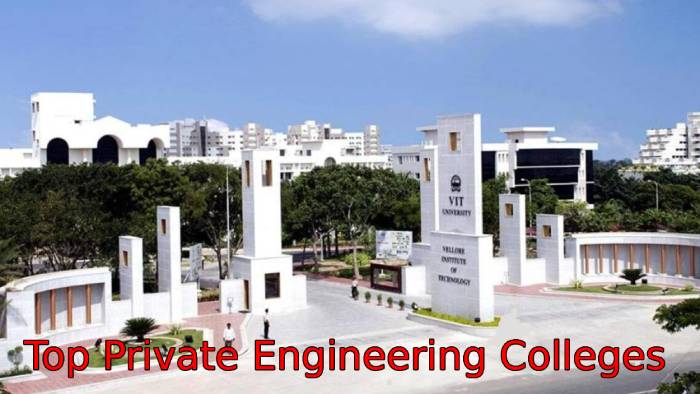
Private Engineering Colleges in India (Ranking Wise 2026)
| Rank | College / University | Location | Established | Popular Courses | Admission Process |
| 1 | Birla Institute of Technology and Science Pilani | Pilani, Rajasthan | 1964 | B.Tech, M.Tech, PhD | BITSAT Entrance Exam |
| 2 | Vellore Institute of Technology | Vellore, Tamil Nadu | 1984 | B.Tech, M.Tech | VITEEE Entrance Exam |
| 3 | SRM Institute of Science and Technology | Chennai, Tamil Nadu | 1985 | B.Tech, M.Tech | SRMJEEE Entrance Exam |
| 4 | Thapar Institute of Engineering and Technology | Patiala, Punjab | 1956 | B.Tech, M.Tech | JEE Main / Institute Counselling |
| 5 | Amrita Vishwa Vidyapeetham | Coimbatore, Tamil Nadu | 2003 | B.Tech, M.Tech | AEEE Entrance Exam |
| 6 | Siksha ‘O’ Anusandhan University | Bhubaneswar, Odisha | 2007 | B.Tech, M.Tech | SAAT Entrance Exam |
| 7 | Kalinga Institute of Industrial Technology | Bhubaneswar, Odisha | 1992 | B.Tech, M.Tech | KIITEE Entrance Exam |
| 8 | Amity University Noida | Noida, Uttar Pradesh | 2005 | B.Tech, M.Tech | JEE Main / University Entrance |
| 9 | Chandigarh University | Mohali, Punjab | 2012 | B.Tech, M.Tech | CUCET Entrance Exam |
| 10 | Lovely Professional University | Phagwara, Punjab | 2005 | B.Tech, M.Tech | LPUNEST Entrance Exam |
Best Private Engineering Colleges Eligibility Criteria 2026
Leading private institutes such as Birla Institute of Technology and Science Pilani, Vellore Institute of Technology, SRM Institute of Science and Technology, and Lovely Professional University follow admission guidelines based on educational qualification, entrance exams, and minimum marks criteria.
Educational Qualification
- Candidates must have passed Class 12 (10+2) or equivalent examination from a recognized board. The required subjects usually include Physics, Chemistry, and Mathematics (PCM). Students who are appearing in the 12th board examination in 2026 may also apply provisionally for admission.
Minimum Marks Requirement
- Most private engineering colleges require at least 50% to 60% aggregate marks in Physics, Chemistry, and Mathematics in the qualifying examination. However, top private institutes may require higher marks depending on their admission policies.
Entrance Examination
Admission to private engineering colleges is usually based on university-level entrance exams or national-level tests. Some common entrance exams include:
- BITSAT for admission to Birla Institute of Technology and Science Pilani
- VITEEE for Vellore Institute of Technology
- SRMJEEE for SRM Institute of Science and Technology
- LPUNEST for Lovely Professional University
Some universities may also accept scores from national exams like Joint Entrance Examination Main.
Age Limit
- Applicants should generally be at least 17 years old at the time of admission. Some universities may specify an upper age limit depending on their admission guidelines.
Nationality Requirement
- Candidates applying for engineering programs must be Indian citizens, although many private universities also offer seats for international students, NRIs, and foreign nationals under special admission categories.
Counselling and Admission Process
- After qualifying the entrance exam, students must participate in the university counselling or seat allocation process where they can choose their preferred branch and campus based on their rank and eligibility.
Private Engineering Colleges Fees 2026
The fee structure of private engineering colleges in India is usually higher than government institutes because private universities invest heavily in infrastructure, laboratories, global collaborations, and campus facilities. The total cost of a B.Tech program in private colleges generally ranges from ₹8 lakh to ₹25 lakh for four years, depending on the university, specialization, and hostel facilities.
| College / University | Average Tuition Fee (Per Year) | Total B.Tech Fees (4 Years) |
| Birla Institute of Technology and Science Pilani | ₹5.4 – ₹5.6 Lakhs | ₹24 – ₹25 Lakhs |
| Vellore Institute of Technology | ₹1.9 – ₹3.8 Lakhs | ₹10 – ₹17 Lakhs |
| SRM Institute of Science and Technology | ₹3.7 – ₹4.8 Lakhs | ₹18 – ₹22 Lakhs |
| Manipal Institute of Technology | ₹3.3 – ₹3.6 Lakhs | ₹16 – ₹18 Lakhs |
| Thapar Institute of Engineering and Technology | ₹3.5 – ₹4.0 Lakhs | ₹17 – ₹19 Lakhs |
| Amrita Vishwa Vidyapeetham | ₹3.0 – ₹3.5 Lakhs | ₹14 – ₹16 Lakhs |
| Kalinga Institute of Industrial Technology | ₹4.2 – ₹4.7 Lakhs | ₹18 – ₹20 Lakhs |
| Lovely Professional University | ₹2.4 – ₹3.2 Lakhs | ₹8 – ₹12 Lakhs |
Private Engineering Colleges Salary Package 2026
According to recent placement data from education portals and placement reports, the average salary in top private engineering colleges usually ranges between ₹8 LPA and ₹16 LPA (Approximate), while some students receive much higher international or product-company packages.
| College / University | Average Salary Package | Median Salary | Highest Package (Approx.) |
| Birla Institute of Technology and Science Pilani | ₹25 – ₹30 LPA | ₹15 – ₹18 LPA | ₹40 LPA+ |
| Vellore Institute of Technology | ₹9 – ₹10 LPA | ₹7 – ₹9 LPA | ₹50 LPA+ |
| SRM Institute of Science and Technology | ₹7 – ₹8 LPA | ₹6 – ₹7 LPA | ₹20 – ₹45 LPA |
| Manipal Institute of Technology | ₹8 – ₹9 LPA | ₹6 – ₹7 LPA | ₹40 LPA+ |
| Thapar Institute of Engineering and Technology | ₹10 – ₹12 LPA | ₹8 – ₹10 LPA | ₹40 LPA+ |
| Amrita Vishwa Vidyapeetham | ₹8 – ₹9 LPA | ₹6 – ₹7 LPA | ₹15 – ₹20 LPA |
| SASTRA University | ₹9 – ₹10 LPA | ₹7 – ₹8 LPA | ₹20 LPA+ |
| Shiv Nadar University | ₹9 – ₹11 LPA | ₹7 – ₹8 LPA | ₹30 LPA+ |
Benefits of Top Private Engineering Colleges in India
mostly private engineering colleges in India have become popular among students because they offer modern education systems, industry-oriented training, and strong placement opportunities.
Modern Infrastructure and Facilities
- Top private engineering colleges usually have advanced laboratories, smart classrooms, modern libraries, research centers, and well-developed campuses. These facilities help students gain practical knowledge and improve their technical skills.
Industry-Oriented Curriculum
- Many private universities regularly update their engineering curriculum according to industry requirements. Students learn practical technologies such as artificial intelligence, data science, cloud computing, and robotics, which are highly demanded in the job market.
Strong Placement Support
- Private engineering colleges maintain partnerships with leading companies to provide campus placement opportunities, internships, and industry training programs. Many multinational companies visit campuses every year to recruit skilled graduates.
Global Exposure and Collaborations
- Several top private universities collaborate with international universities and research institutions. This allows students to participate in exchange programs, global internships, and joint research projects.
Skill Development Programs
- Private engineering colleges focus on skill-based learning, certification courses, workshops, and technical training programs. These activities help students develop communication skills, problem-solving abilities, and industry knowledge.
Scholarship Opportunities
- Many private universities offer scholarships based on merit, entrance exam scores, or financial background. These scholarships help students reduce their education expenses.
Wide Range of Specializations
- Private engineering colleges often offer many modern B.Tech specializations such as Artificial Intelligence, Cyber Security, Data Science, Machine Learning, and Internet of Things (IoT), giving students more career options.
Top Recruiters in Private Engineering Colleges 2026-27
These companies recruit students for roles in software development, consulting, data science, core engineering, and management fields.
| Industry Sector | Top Recruiting Companies |
| IT & Software Companies | Google, Microsoft, Amazon, Adobe, PayPal |
| IT Services & Consulting | TCS, Infosys, Wipro, Cognizant, Accenture |
| Product & Technology Companies | Cisco, Oracle, IBM, Samsung, Intel |
| Finance & Consulting Firms | Deloitte, KPMG, Goldman Sachs, JP Morgan |
| Manufacturing & Core Engineering | Tata Motors, Bosch, L&T, Mahindra & Mahindra |
| E-commerce & Startups | Flipkart, Myntra, Zomato, Paytm |
Conclusion
In addition, private engineering colleges provide global exposure, research opportunities, and a wide range of modern B.Tech specializations that help students stay competitive in today’s technology-driven world. With strong industry connections and campus recruitment support, graduates from these institutes often secure jobs in leading national and international companies.